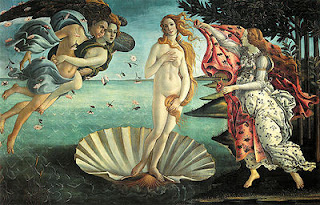
Showing posts with label Botticelli. Show all posts

Monday, February 4, 2013

Ode on Intimations of Immortality from Recollections of Early Childhood


There was a time when meadow, grove, and stream, 
The earth, and every common sight
                 To me did seem
            Apparelled in celestial light,
The glory and the freshness of a dream.
It is not now as it hath been of yore;--
             Turn wheresoe'er I may,
              By night or day,
The things which I have seen I now can see no more.

            The rainbow comes and goes, 
            And lovely is the rose; 
            The moon doth with delight
     Look round her when the heavens are bare;
            Waters on a starry night
            Are beautiful and fair;
     The sunshine is a glorious birth;

PLATE IV.—PASTORALE, Boucher, Louvre)
     But yet I know, where'er I go,
That there hath past away a glory from the earth.

Now, while the birds thus sing a joyous song,
     And while the young lambs bound
            As to the tabor's sound,
To me alone there came a thought of grief:
A timely utterance gave that thought relief, 
            And I again am strong.
The cataracts blow their trumpets from the steep,--
No more shall grief of mine the season wrong:
I hear the echoes through the mountains throng.
The winds come to me from the fields of sleep, 
            And all the earth is gay;
                Land and sea
     Give themselves up to jollity,
            And with the heart of May
     Doth every beast keep holiday;--
                Thou child of joy,
Shout round me, let me hear thy shouts, thou happy 
        Shepherd-boy!
Ye blesséd Creatures, I have heard the call 
     Ye to each other make; I see
The heavens laugh with you in your jubilee; 
     My heart is at your festival,
       My head hath its coronal,
The fulness of your bliss, I feel--I feel it all.
         O evil day! if I were sullen 
         While Earth herself is adorning
              This sweet May-morning;
         And the children are culling
              On every side
         In a thousand valleys far and wide
         Fresh flowers; while the sun shines warm, 
And the babe leaps up on his mother's arm:--
         I hear, I hear, with joy I hear!
         --But there's a tree, of many, one, 
A single field which I have look'd upon, 
Both of them speak of something that is gone:
              The pansy at my feet
              Doth the same tale repeat:
Whither is fled the visionary gleam? 
Where is it now, the glory and the dream?

Le Repos, William-Adolphe Bouguereau
Our birth is but a sleep and a forgetting; 
The Soul that rises with us, our life's Star,
          Hath had elsewhere its setting
               And cometh from afar;
          Not in entire forgetfulness,
          And not in utter nakedness,
But trailing clouds of glory do we come 
               From God, who is our home:
Heaven lies about us in our infancy! 
Shades of the prison-house begin to close
               Upon the growing Boy,
But he beholds the light, and whence it flows, 
               He sees it in his joy;
The Youth, who daily farther from the east 
     Must travel, still is Nature's priest,
          And by the vision splendid
          Is on his way attended;
At length the Man perceives it die away, 
And fade into the light of common day.

Earth fills her lap with pleasures of her own; 
Yearnings she hath in her own natural kind, 
And, even with something of a mother's mind,
               And no unworthy aim,
          The homely nurse doth all she can 
To make her foster-child, her inmate, Man,
               Forget the glories he hath known,
And that imperial palace whence he came.

La Jeuness de Bacchus, William-Adolphe Bouguereau
Behold the Child among his new-born blisses,
A six years' darling of a pigmy size!
See, where 'mid work of his own hand he lies,
Fretted by sallies of his mother's kisses,
With light upon him from his father's eyes!
See, at his feet, some little plan or chart,
Some fragment from his dream of human life,
Shaped by himself with newly-learned art;
          A wedding or a festival, 
          A mourning or a funeral;
               And this hath now his heart,
          And unto this he frames his song:
               Then will he fit his tongue
To dialogues of business, love, or strife; 
          But it will not be long 
          Ere this be thrown aside, 
          And with new joy and pride
The little actor cons another part;
Filling from time to time his 'humorous stage'
With all the Persons, down to palsied Age,
That life brings with her in her equipage; 
          As if his whole vocation
          Were endless imitation.
Primavera, Botticelli,  c. 1482 Tempra on Panel, Uffizi, Florence

Thou, whose exterior semblance doth belie 
          Thy soul's immensity;
Thou best philosopher, who yet dost keep
Thy heritage, thou eye among the blind,
That, deaf and silent, read'st the eternal deep,
Haunted for ever by the eternal Mind,--
          Mighty Prophet! Seer blest!
          On whom those truths rest
Which we are toiling all our lives to find,
In darkness lost, the darkness of the grave;
Thou, over whom thy Immortality
Broods like the day, a master o'er a slave,
A Presence which is not to be put by; 
          To whom the grave
Is but a lonely bed, without the sense of sight
Of day or the warm light,
A place of thoughts where we in waiting lie;
Thou little child, yet glorious in the might
Of heaven-born freedom on thy being's height,
Why with such earnest pains dost thou provoke
The years to bring the inevitable yoke,
Thus blindly with thy blessedness at strife?
Full soon thy soul shall have her earthly freight,
And custom lie upon thee with a weight
Heavy as frost, and deep almost as life!
          0 joy! that in our embers
          Is something that doth live,
          That Nature yet remembers
          What was so fugitive!
The thought of our past years in me doth breed
Perpetual benediction: not indeed
For that which is most worthy to be blest,
Delight and liberty, the simple creed
Of Childhood, whether busy or at rest,
With new-fledged hope still fluttering in his breast:--
          --Not for these I raise
          The song of thanks and praise;
     But for those obstinate questionings
     Of sense and outward things,
     Fallings from us, vanishings,
     Blank misgivings of a creature
Moving about in worlds not realized, 
High instincts, before which our mortal nature 
Did tremble like a guilty thing surprised:
     But for those first affections,
     Those shadowy recollections,
          Which, be they what they may,
Are yet the fountain-light of all our day, 
Are yet a master-light of all our seeing;
     Uphold us--cherish--and have power to make 
Our noisy years seem moments in the being 
Of the eternal Silence: truths that wake,
               To perish never;
Which neither listlessness, nor mad endeavour,
               Nor man nor boy,
Nor all that is at enmity with joy,
Can utterly abolish or destroy!
   Hence, in a season of calm weather
          Though inland far we be,
Our souls have sight of that immortal sea
               Which brought us hither;
          Can in a moment travel thither--
And see the children sport upon the shore, 
And hear the mighty waters rolling evermore.

Idylle, William-Adolphe Bouguereau
Then, sing, ye birds, sing, sing a joyous song!
          And let the young lambs bound
          As to the tabor's sound!
     We, in thought, will join your throng, 
          Ye that pipe and ye that play, 
          Ye that through your hearts to-day 
          Feel the gladness of the May!
What though the radiance which was once so bright 
Be now for ever taken from my sight,
     Though nothing can bring back the hour 
Of splendour in the grass, of glory in the flower;
          We will grieve not, rather find
          Strength in what remains behind;
          In the primal sympathy
          Which having been must ever be;
          In the soothing thoughts that spring
          Out of human suffering;
          In the faith that looks through death, 
In years that bring the philosophic mind.

Vulcan Presenting Venus with Arms for Aeneas, 1757, Oil on Campus, Boucher, Louvre

And 0, ye Fountains, Meadows, Hills, and Groves,
Forebode not any severing of our loves!
Yet in my heart of hearts I feel your might;
I only have relinquish'd one delight
To live beneath your more habitual sway;
I love the brooks which down their channels fret
Even more than when I tripp'd lightly as they;
The innocent brightness of a new-born day
               Is lovely yet;
The clouds that gather round the setting sun
Do take a sober colouring from an eye
That hath kept watch o'er man's mortality; 
Another race hath been, and other palms are won.
   Thanks to the human heart by which we live,
   Thanks to its tenderness, its joys, and fears,
   To me the meanest flower that blows can give
   Thoughts that do often lie too deep for tears.

~ William Wordsworth

Friday, June 29, 2012

In Zakynthos


Birth of Venus, 1862, Oil On Canvas,
Eugène Amaury-Duval (copyright at bottom)


No more and never will touch the sacred shores
where the little boy lay my body, 
Zakynthos mine that mirrors you nell'onde 
the greek virgin birth came in off sea 

Venus and fea those fertile islands
with his first smile,

so not silent clear your clouds
and your leaves
towards the illustrious man who waters 


Ulysses Returns Chryseis to her Father, c. 1644,
Oil on Canvas, Claude Lorrain (copyright at bottom)

sang fatal, and a different exile 
so nice of fame and misfortune 
kissed her stony Ithaca Ulysses. 


You do not have nothing but the singing of his son,
or my mother earth, we prescribed 
Fate illacrimata burial. 

Alone, Illustration for Edgar Allen Poe, Edmund Dulac


~ Ugo Foscolo

"The sonnet begins with a triple negation (which is a bitter realization of the poet's loss of his home), and ends with the final judgment of his exile and his illacrimata burial in a foreign land. Between these two poles is contained negative, through the binding of the images and wonderful nostalgic representation of the ideal world of the poet of childhood and the mythical transfiguration of his own experience of exile that is through the analogy between his figure is that of Ulysses. Ulysses, "looking for fame and misfortune" is the image of the poet, himself an exile magnanimously opposed by fate and by man, but above all represents the new concept of the romantic hero, the great strength and dignity with which bears the ravages of misfortune (the exile hesitated, however, will be different; Foscolo unlike Ulysses will be buried in a foreign land and no one will pay for the teardrops on his grave). Other mythic images are also present in the verses, which is that of Homer's poetry eternatrice and heroism of the highest values ​​and Venus, according to myth was born from the foam of the sea, symbol of the fertilizing nature, beauty and harmony, which With her smile has made fruitful and flourishing homeland of the poet (http://www.antelitteram.com/antologia/foscolo.htm)." 

"Fate illacrimata burial" is essentially an unmourned and unlamented burial..... 


Birth of Venus, Eugène Amaury-Duval, 1862, Oil On Canvas, 197x109 cm, Musée des Beaux-Arts de Lille,Image and original data provided by Réunion des Musées Nationaux / Art Resource, N.Y., http://www.artres.com/c/htm/Home.aspx, Rights -Contact information: Ryan Jensen, General Manager, Art Resource, 536 Broadway (5th floor), New York, N.Y. 10012; Tel No: (212) 505-8700; Fax: (212) 505-2653; Email: RJensen@artres.com / Please note that if this image is under copyright, you may need to contact one or more copyright owners for any use that is not permitted under the ARTstor Terms and Conditions of Use or not otherwise permitted by law. While ARTstor tries to update contact information, it cannot guarantee that such information is always accurate. Determining whether those permissions are necessary, and obtaining such permissions, is your sole responsibility.


Ulysses Returns Chryseis to her Father, Claude Lorrain, c. 1644, Oil on Canvas, 119x150 cm, Musée du Louvre,Image and original data provided by SCALA, Florence/ART RESOURCE, N.Y. / http://www.artres.com/c/htm/Home.aspx & http://www.scalarchives.com / Image Rights:(c) 2006, SCALA, Florence / ART RESOURCE, N.Y. Please note that if this image is under copyright, you may need to contact one or more copyright owners for any use that is not permitted under the ARTstor Terms and Conditions of Use or not otherwise permitted by law. While ARTstor tries to update contact information, it cannot guarantee that such information is always accurate. Determining whether those permissions are necessary, and obtaining such permissions, is your sole responsibility.

Tuesday, August 9, 2011

Particular Fondness for the Academies

William Bouguereau has to be one of my favorite of the more 'modern' painters because of his training in the Academic Style and his loyalty to the Academic style.  Bouguereau was a master of incorporating in the literature he studied with the paintings he did and painted a wide array of mythical and religious topics.  Even in an age when artists were rebelling against the Academies like Matisse and Degas, who had no love for Bouguereau's slick finished style, Bouguereau held fast to his love of the literature, arts, and style of the academies.


This painting is called Art and Literature:
L'art et la litterature, William-Adolphe Bouguereau, 1867, Oil on canvas, 78-3/4 x 42-1/2"
(Art and Literature, c. 1867, Oil on Canvas, William-Adolphe Bouguereau, Arnot Art Museum Elmira)


The Birth of Venus shows Bouguereau's exceptional grasp of form and skill in painting the human form, particularly the female human body.  The idealized world of mythology, gods, goddesses, nymphs, and legends is were Bouguereau prevailed in the accurate details, beautiful renderings of flesh, and symbolism.

William Bouguereau, Naissance de Vénus, en 1879, huile sur toile, H. 3. ; L. 2.15, musée d'Orsay, Paris, France
©photo musée d'Orsay / rmn (The Birth of Venus, 1879, Oil on Canvas, William-Adolphe Bouguereau, Musee d'Orsay, Paris)


To compare this with a classical masterpiece below is Botticelli's Birth of Venus, 1486 nearly 400 years earlier

Birth of Venus, c. 1486, Tempera on Canvas, Sandro Botticelli, Uffizi Gallery, Florence


Botticelli, displays all the symbolism, iconography, and mythology in his painting present in Bouguereau's painting, but Bouguereau brings in an element of a more 'real' female heroine with the realistic flesh and form of Venus.  She is painted in a manner appearing perfect yet she could be real unlike Botticelli's who still appears as if only a dream.

Friday, August 5, 2011

Salvador Dali and his links to Velazquez in Infanta Margarita

Velazquez Painting the Infanta Margarita with the Lights and Shadows of his own Glory, Salvador Dali, 1958, Salvador Dali Museum, St. Petersburg, Fl (Image retrieved from www.artsunlight.com)
Salvador Dali was a huge fan of artists who came before him, particularly Renaissance and Baroque artists and he frequently took their masterpieces and altered them in his artwork as homage to their work.  Often when visitors come into the Dali museum in St. Petersburg, FL either they are overwhelmed by the full canvases and do not recognize the images within the images, they do see the images of previous artworks but cannot place them to any specific artist, they vaguely recognize an image within a work, they do recognize the image and feel Dali has destroyed the image, or they know Dali's work and realize he has the utmost respect for the artists.  


For anyone unfamiliar with Dali, I highly recommend going to the museum and having a Docent take you around for at least the first part of a visit.  The Dali museum of all the museum's I have been to has to be heads and shoulders above the rest regarding how passionate they are about the artist; how focused they are on his work; how knowledgeable about his symbology, iconography, life, and history; and how they truly take their time to make the visit enjoyable and exciting.  


I love Velazquez so for me this is one of my favorite Dali pieces (I actually have several thanks to his love of Botticelli, Vermeer, DaVinci, ect. and his skill at symbology).  Dali painted 'Velazquez Painting the Infanta margarita with the Lights and Shadows of his own Glory'  around the time of the 300th anniversary of Velazquez's death in an American Abstract Expressionist style after Kooning in New York.  Much like Dali states that Kooning is 'the colossus straddling the Atlantic with one foot in New York and the other in Amsterdam' Dali's painting of the Infanta is straddling two worlds.  On the upper right corner of the canvas is the depiction of a room in Prado which contains paintings, sculptures, and various objects typically found in studio of a 'great master painter', the Infanta's face is portrayed utilizing the horns of a rhinoceros, the left hand of the Infanta is painted using atomic particles on a photographic film alluding to scientific discoveries and artistic discoveries.  So Dali is cleverly and deliberately paying homage to the great masters while incorporating the new age of scientific discovery and artistic style and discovery into the work.


Dali did not to my knowledge ever accidentally place anything on a canvas.  He was highly skilled at his  meaning in a meaning in a meaning in a meaning... I could sit for hours at one canvas to only go back another time to the museum only to find more.  He truly was a master in his own right.


The Infanta, Diego Velazquez, 1660, Oil on Canvas, Museo Nacional del Prado, Madrid (retrieved www.WMOFO.com)

Tuesday, July 5, 2011

The Goddess


 "
Aphrodite I shall sing to whose domain
“
Of august gold-wreathed and beautiful
belong the battlements of all sea-loved
Cyprus where, blown by the moist breath
of Zephyros, she was carried over the
waves of the resounding sea on soft foam.
The gold-filleted Horae happily welcomed
her and clothed her with heavenly raiment.”
~Demetrios Chalcondyles