Showing posts with label Neoclassicism. Show all posts

Sunday, August 14, 2011

The Sun Rising ~ by John Donne

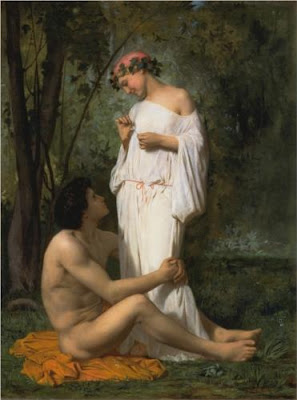
Idylle, 1851, Oil on Canvas, William-Adolphe Bouguereau, Neoclassicism


The Sun Rising


 Busy old fool, unruly Sun, 
        Why dost thou thus,
Through windows, and through curtains, call on us? 
Must to thy motions lovers' seasons run? 
        Saucy pedantic wretch, go chide 
        Late school-boys and sour prentices, 
    Go tell court-huntsmen that the king will ride, 
    Call country ants to harvest offices;
Love, all alike, no season knows nor clime, 
Nor hours, days, months, which are the rags of time. 


        Thy beams so reverend, and strong 
        Why shouldst thou think? 
I could eclipse and cloud them with a wink, 
But that I would not lose her sight so long. 
        If her eyes have not blinded thine, 
        Look, and to-morrow late tell me, 
    Whether both th' Indias of spice and mine 
    Be where thou left'st them, or lie here with me. 
Ask for those kings whom thou saw'st yesterday, 
And thou shalt hear, "All here in one bed lay." 


        She's all states, and all princes I;
        Nothing else is; 
Princes do but play us; compared to this, 
All honour's mimic, all wealth alchemy. 
        Thou, Sun, art half as happy as we, 
        In that the world's contracted thus; 
    Thine age asks ease, and since thy duties be 
    To warm the world, that's done in warming us. 
Shine here to us, and thou art everywhere; 
This bed thy center is, these walls thy sphere.


~~~~~~~~~~~~~~~~~~~~~~~~~~~~~~~


Donne loves to use the sphere in his poetry as he does in this poem... he speaks of the sun, the earth, the eyes, an eclipse, and directly the sphere.... all things to him seem cyclical and love seems to be no exception.  Love is addressed as a metaphysical love staged inside the bedroom as if it was representative of the world because for the lover the whole world is contained in his love when he writes 'To warm the world, that's done in warming us. / Shine here to us, and thou art everywhere;'.  His line, 'no season knows, nor clime, / Nor hours, days, months, which are the rags of time' are a testament to his importance on the subject of love as it supersedes all else including kings, the princes, and the universe itself.  

Tuesday, August 9, 2011

Particular Fondness for the Academies

William Bouguereau has to be one of my favorite of the more 'modern' painters because of his training in the Academic Style and his loyalty to the Academic style.  Bouguereau was a master of incorporating in the literature he studied with the paintings he did and painted a wide array of mythical and religious topics.  Even in an age when artists were rebelling against the Academies like Matisse and Degas, who had no love for Bouguereau's slick finished style, Bouguereau held fast to his love of the literature, arts, and style of the academies.


This painting is called Art and Literature:
L'art et la litterature, William-Adolphe Bouguereau, 1867, Oil on canvas, 78-3/4 x 42-1/2"
(Art and Literature, c. 1867, Oil on Canvas, William-Adolphe Bouguereau, Arnot Art Museum Elmira)


The Birth of Venus shows Bouguereau's exceptional grasp of form and skill in painting the human form, particularly the female human body.  The idealized world of mythology, gods, goddesses, nymphs, and legends is were Bouguereau prevailed in the accurate details, beautiful renderings of flesh, and symbolism.

William Bouguereau, Naissance de Vénus, en 1879, huile sur toile, H. 3. ; L. 2.15, musée d'Orsay, Paris, France
©photo musée d'Orsay / rmn (The Birth of Venus, 1879, Oil on Canvas, William-Adolphe Bouguereau, Musee d'Orsay, Paris)


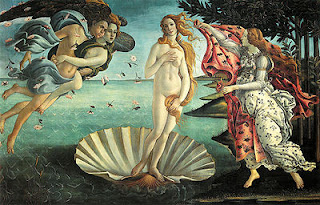
To compare this with a classical masterpiece below is Botticelli's Birth of Venus, 1486 nearly 400 years earlier

Birth of Venus, c. 1486, Tempera on Canvas, Sandro Botticelli, Uffizi Gallery, Florence


Botticelli, displays all the symbolism, iconography, and mythology in his painting present in Bouguereau's painting, but Bouguereau brings in an element of a more 'real' female heroine with the realistic flesh and form of Venus.  She is painted in a manner appearing perfect yet she could be real unlike Botticelli's who still appears as if only a dream.