Showing posts with label Michelangelo. Show all posts

Wednesday, August 15, 2012

Masaccio Remembered

Masaccio, Italian artist who was buried in the Carmelite Church in 1443 CE was only somewhat known for his art during his lifetime.  The Renaissance artists and rivalries which would give individual artists like Michelangelo, Leonardo, Botticelli, Titian, and Raphael individuality had only just begun by the end of his life.  Although there was no memorial erected in his honor, there are two epitaphs which are befitting such a wonderful artist, both of course are in the form of poetry: 

I painted, and my picture was like life;
  I gave my figures movement, passion, soul:
They breathed. Thus, all others
  Buonarroti taught; he learnt from me.

By Annibal Caro, Italian Poet


and 


O jealous Fate, why doth thy finger fell
 Asunder pluck the threads of youth's first bloom?
Countless Apelles this one slaying slays;
 In this one death there dies all painting's charm.
With this sun's quenching, all the stars are quench'd;
 Beside this fall, alas! all beauty falls.

By Fabio Segni (Translated from Italian)

Source for the poetry: Vasari, Giorgio. Lives of the Artists. Translated by Bull, George. Penguin Books.


Masaccio, one of the predecessors to the Great Masters of the Renaissance was studied closely by many of the Great Masters and it is speculated that Michelangelo studied Masaccio by making sketches and drawings which surpassed the works of Masaccio.  The amount of drawings is information which is debated by art historians including Vasari. 
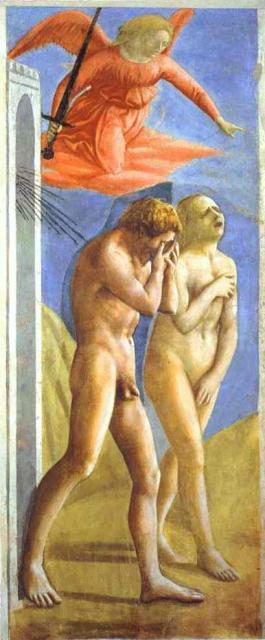

Expulsion from Eden, Masaccio, fresco from Brancacci Chapel, Florence.
Image from
 http://archives.evergreen.edu/webpages/curricular/2006-2007/greeceanditaly/massacio-expulsion-from-eden-1427-fresco-from-brancacci-chapel-florence/index.html

Masaccio's Expulsion from Eden, 1427, fresco from Brancacci Chapel, Florence was drawn by Michelangelo (Copy of Masaccio, Expulsion c.1490).


Copy of Masaccio, Expulsion. Michelangelo, Drawing, c. 1490

Tribute Money, located in the Chapel of Santa Maria della Carmine, Florence, Italy is perhaps one of the most recognized works of Masaccio.  Masaccio based the heads of the figures on classical heads yet his figures were akin to Donatello's.

Tribute Money, Fresco, 1426-28, 255 x 598 cm, Masaccio, Chapel of Santa Maria della Carmine in
Florence, Italy. Image from Hanover College

Masaccio was not the inventor of linear perspective but perhaps completed one of the early Renaissance's most effective use of perspective in The Holy Trinity.  Unknowingly, Masaccio would further the argument of mathematics as a true science. Masaccio constructed the fresco carefully according to the lines of linear perspective which Brunelleschi had perfected and painted the work to be seen from eye-level.  

The Holy Trinity, 1425, Masaccio. Santa Maria Novella, Florence, Italy. Here the lines following Masaccio's actual geometric framework are overlaid to make clear the structure of the perspective itself. Image obtained from McMurry University

The viewer first encounters the skeleton and inscription "I was once that which you are; and that which I am you will become." The viewer is meant by the gaze of only one individual in the fresco, the Virgin who invites the viewer into this constructed illusion and hence into contemplation of their humanity and meditation on her son.

 The Holy Trinity, 1425, Masaccio. Santa Maria Novella, Florence, Italy
Image obtained from http://legacy.earlham.edu/~vanbma/20th%20century/images/surveydaytwentynine.htm


Tuesday, August 14, 2012

Give Back, O Silver Stream and Fountain Bright.... Michelangelo

    Give back, O silver stream and fountains bright,
the constant spring you borrowed from my eyes,
the power not yours that makes you swell and rise,
the flow that nature never made so great.
     And you, dense air, that shade the heavenly light
from these sad orbs and thicken with my sighs,
restore them to the heart that weary lies,
clear your dark faces to my new sharpened sight.
     Now let the earth give back my foot's hard print
that grass may grow on what was trodden bare,
echo, long deaf, send back my loud lament; 
     and may your holy lights at last set free
my longing looks to sometime love another
beauty, since you have no delight in me.

Michelangelo
Probably to T. C.

Buonarroti, Michelangelo. "Poems". Michelangelo; Poems and Letters. Translated with an Introduction and Notes by    Anthony Mortimer. London, England: Penguin Classics, 2007.

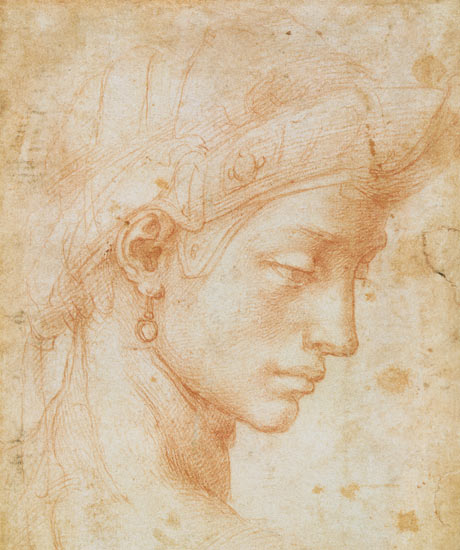
No matter who Michelangelo's heart belonged to his works were rarely rivaled.  His sketches are quite telling of the amount of time and attention given to his art, which I suspect was is true love before all else.....

Ideal Head, Michelangelo. Print available by appointment at the Ashmolean Museum  print room by appointment http://www.ashmolean.org/departments/westernart/printroom/collections/?s=Michelangelo

Ideal Head of a Woman, Michelangelo, Drawing, British Museum

Study of A Head, Michelangelo


A Youth Beckoning, Pen and brown ink on paper. c. 1504-05. The British Museum, London 


Wednesday, February 15, 2012

Baroque and Mannerist Sculpture in Italy

As I begin to save to travel abroad this summer I reflect on my brief stay in Florence last summer.  I truly regret having e-coli, but not my rainy day lost when I turned the corner to encounter the David in the Piazza della Signoria.  The Piazza would become a pass thru and a stopping point over the next 10 days until my departure to marvel at the works left in large part due to the Medici family.

David, 1504, Michelangelo, Piazza della Signora, Photo Taken May 2011
Menelaus Supporting the Body of Patroclus, Roman Sculpture, Piazza della Signora, Photo Taken May 2011

Perseus with the Head of Medusa, Cellini, 1554, Piazza della Signora, Photo Taken May 2011
Rape of Polyxena, Pio Fedi, 1892, Piazza della Signora, Photo taken May 2011 (for anyone not familiar with the term, rape during this time meant kidnap)

Lion of the Loggia dei Lanzi, Medici Lions, Photo taken May 2011

Hercules and the Centaur, Giambologna, 1600, Piazza della Signora, Photo taken May 2011

I look forward to the adventures in Europe this summer without e-coli (fingers crossed)......

Sunday, November 27, 2011

Michelangelo - Fragment 35, Before 1547

      Nobody has the whole of it
before he reaches his limit
of his art and his life. ~ Michelangelo


If one of the greatest of masters of art who brought marble to life, fresco off the wall, and drawing to new heights in the 1500's which were still marveled and reveled in our time, what limits do you suppose he aspired to?


David, 1504, Florence, Italy Michelangelo

Pieta, 1499, The Vatican at St. Peter's Basilica, Rome, Italy, Michelangelo


The Sistine Chapel, Vatican, Vatican City, 1508-1512

Today is rather short and the days in-between my posts rather long.... I fear graduate school at times drains the time for the arts I love and am passionate about.... so Michelangelo feared he was not doing enough and he accomplished so much... who am I to say I am tired, I am busy, I am over-run??


Monday, July 18, 2011

Just think.... Michelangelo and Botticelli

La Primavera, c. between 1477 and 1482, Sandro Botticelli, Uffizi Gallery Museum, Florence, Italy

How joyful is the garland finely tressed
With flowers linked to crown her golden hair,
Each pressing close upon the one before
To kiss her head, vying to be the first!

Happy all day the gown that clasps her breast
And then below floats freely to the air,
And that spun gold, the net delighting where
It touches cheeks and neck and never rests.

But surely happier the ribbon placed
With golden tips in a such a lucky manner
To press and touch the breast where it is laced.

And round her waist the simple girdle seems
To whisper low: here let me cling forever.
Just think what could circle with my arms.

Michelangelo 1507

Wednesday, July 13, 2011

Diary Entry by Michelangelo c. 1546

Detail of 'Venus and Anchises, 1597-1600, Fresco, Farnese Gallery, Rome, Italy

 'Fierce burning for surpassing loveliness
need not be always harsh and deadly fault,
if with that heat the heart is made to melt 
in softness that a dart divine can pierce.
   Winged by the power of love, man wakes and soars,
nor is vain passion denied a loftier flight
as the first step to the creator's height,
to which the soul, unsated, seeks to rise.
   The love of which I speak aspires to climb; 
women are not like this, and it ill fits
a wise and manly heart to burn for them.
   One draws to heaven, the other to earth below,
one in the soul, one in the senses sits
and at things vile and worthless draws his bow.'


~Michelangelo (Probably for T.C.)


Annibale Carracci, The Farnese Gallery, Detail of 'Venus and Anchises, 1597-1600, The quotation on the footstool is from Virgil's Aeneid indicates the pair are illusionistic stone 'Atlas Figures' - In front of them are very fleshy figures  based on the Ignudi of Michelangelo's Sistine ceiling.

Buonarroti, M. (2007). Poems and letters (michelangelo). Penguin Classics.

Sunday, June 19, 2011

Confined by the Excess

The Vatican Pieta, 1499, Michelangelo, Saint Peter's Basilica, Vatican City


 'The best of artists can no concept find
that is not in a single block of stone,
confined by the excess; to that alone
attains the hand obedient to the mind.
  Noble and gracious lady, most divine,
the evil that I flee and good I crave
thus hide in you; but, that I may not live,
my art proves contrary to my design.
  Not love then, nor your beauty or disdain,
your harshness or fortune or my fate
or destiny is guilty of my pain,
  if in your heart at once you carry both mercy and death, and if my lowly wit,
burning, draws from it nothing else but death.'
~ Michelangelo

Photo from May 2011, David (Reproduction), Michelangelo, Piazza della Signoria, Firenze, Italy

Michelangelo wrote many letters, sonnets, and poems and this one in particular he utilized sculpture as his metaphor and shows the plurality in all things. Michelangelo it is said used art theory to make poetry.

Buonarroti, M. (2007). Poems and letters (michelangelo). Penguin Classics.

Friday, June 17, 2011

The Interest in the Mona Lisa and Bypassing Beauty

Image taken at the Louvre (by me) May 2011, Paris France - Mona Lisa,  1503-06, Leonardo Da Vinci, On wood, Louvre Museum, Paris, France
‎"One can have no smaller or greater mastery than mastery of oneself." ~ Leonardo da Vinci was the quote which caught my eye for today and the reason why was that recently I was at the Louvre with a dear friend Whitney noticing I could quite easily move thru the Renaissance and Baroque rooms even though the Louvre was crowded.  I began to wonder why this was so. This of course was a passing thought as I came upon some of Leonardo's works such as 'Virgin of the Rocks', 'Saint John the Baptist', and the 'Virgin and child with Saint Anne', but why was I one of the few stopping.... Oh because everyone was making a 'bee line' to see "(Gioconda or) Mona Lisa'.  
The Virgin and Child With Saint Anne, c. 1508, Leonardo Da Vinci, Louvre Museum, Paris, France 

Saint John the Baptist, 1513-16, Oil on Panel, Leonardo da Vinci, Louvre Museum, Paris France 
So could it be true that they cared so little about his work or was it more true that his work was more advertised in the Mona Lisa? I think the latter is true and do not get me wrong, I was somewhat grateful as I was able to spend time inspecting the 'Virgin of the Rocks' and 'Saint John the Baptist' in particular up close and in detail when the Mona Lisa felt more like trying to see a rock star on stage.  I will not lie, I hoped to see the painting closer to inspect every detail but I did not pass on the details of all the other paintings I could inspect with very little interruption in my two favorite Art History Periods.


For me, viewing art in the beautiful pictures of my art history books is akin to a fairy tale - quite often the lighting is perfect, the angle is perfect, the composition is perfect, all is perfect....the majority of the time. In person, more often than not, photography does not translate real life quite so well.  I was not a Caravaggio, Leonardo, or Dali fan in print, I am in person.  I was enamored with Botticelli's coloration in photography yet missed the intricacy of his works until I could sit at the National Gallery in DC and muse at each detail. 

While my photographs in my textbooks brought me to the museums and caused me to cross the ocean 6,000 miles to see the David (as a friend recited to me) it is the works themselves which hold the true beauty.  Michelangelo's photography did not do his work justice.

So for today, I leave with a favorite quote by a sculptor which is about art and about life in general, which I try so hard to live by:


"...I have been to the same part of the seashore - but each year a new shape of pebble has caught my eye, which the year before, though it was there in hundreds, I never saw." ~Henry Moore, Sculptor