Showing posts with label Art History. Show all posts

Wednesday, September 5, 2012

Ode to Autumn

Ode to Autumn

Season of mists and mellow fruitfulness!
Close bosom-friend of the maturing sun;
Conspiring with him how to load and bless
With fruit the vines that round the thatch-eaves run;
To bend with apples the mossed cottage-trees,
And fill all fruit with ripeness to the core;
To swell the gourd, and plump the hazel shells
With a sweet kernel; to set budding more,
And still more, later flowers for the bees,
Until they think warm days will never cease,
For Summer has o'erbrimmed their clammy cells.


by Jeniffer Sams


Who hath not seen thee oft amid thy store?
Sometimes whoever seeks abroad may find
Thee sitting careless on a granary floor,
Thy hair soft-lifted by the winnowing wind;
Or on a half-reaped furrow sound asleep,
Drowsed with the fume of poppies, while thy hook
Spares the next swath and all its twined flowers;
And sometimes like a gleaner thou dost keep
Steady thy laden head across a brook;
Or by a cider-press, with patient look,
Thou watchest the last oozings, hours by hours.

Where are the songs of Spring? Ay, where are they?
Think not of them, thou hast thy music too, -
While barred clouds bloom the soft-dying day
And touch the stubble-plains with rosy hue;
Then in a wailful choir the small gnats mourn
Among the river sallows, borne aloft
Or sinking as the light wind lives or dies;
And full-grown lambs loud bleat from hilly bourn;
Hedge-crickets sing, and now with treble soft
The redbreast whistles from a garden-croft;
And gathering swallows twitter in the skies.

~ John Keats

Autumn - On the Hudson River, Francis Cropsey, 1860, National Gallery of Art, Washington D. C. 


Tuesday, September 4, 2012

Song To Celia and The Odyssey - Celia and Calypso


Song to Celia

Drinke to me, onely, with thine eyes,
    And I will pledge with mine;
Or leave a kisse but in the cup,
    And Ile not looke for wine.
The thirst, that from the soule doth rise,
    Doth aske a drinke divine:
But might I of Jove's Nectar sup,
   I would not change for thine.
  I sent thee, late, a rosie wreath,
    Not so much honoring thee,
As giving it a hope, that there
    It could not withered bee.
But thou thereon did'st onely breath,
    And sent'st it back to mee:
Since when it growes, and smells, I sweare,
    Not of it selfe, but thee.
   I would not change for thine.
Since when it grows, and smells, I swear,
   Not of itself, but thee.

~ Ben Jonson (1619)

Song to Celia from Poets.org


Jonson uses immortality and eternity symbols such as Jove’s Nectar and a (rosie) wreath i.e. a circle or eternal symbol when he speaks of his love. Much like Donne, Jonson uses the eyes, our “windows to the soul” to flesh out the true nature of Celia’s feelings.

To change the spelling to ‘new English’ would be a mistake, in my opinion as Jonson has already invoked the imagery of Jove (Zeus), nectar - considered by the Greeks to be the ‘Nectar of the Gods’ and hold immortality which is collected by bees from blossoming flowers so the use of bee in line 12 could be said to be a reference to nectar.  Both Jove and nectar are used quite extensively in Homer’s Odyssey. 

Calypso and Odysseus, Oil on canvas, Gerard de Lairesse, Rijks Museum, Amsterdam 
In book V, Homer talks of Calypso who longs for the love of Odysseus who, 'In the nights, true / he'd sleep with her in the arching cave-he had no choice- / unwilling lover alongside lover all too willing... / But all his days he'd sit on the rocks and beaches, / wrenching his heart with sobs and groans and anguish, / gazing over the barren sea through blinding tears. (Homer, The Odyssey, Book V, Lines 170-175)'.  Odysseus loved his wife like Jonson loves Celia and Calypso loves Odysseus. Like Jonson, Calypso will not receive the same eternal and unending love from Odysseus and realizes she must let him go both physically and emotionally. Calypso says to Odysseus, "No need, my unlucky one, to grieve here any longer, / no, don't waste your life away. Now I am willing, / heart and soul, to send you off at last (Homer, The Odyssey, Book V, Lines 177-179)."  Jonson realizes Celia will not return his love the same as he feels when he wrote in lines 13-14, "But thou thereon did'st onely breath, / And sent'st it back to mee".


Both Calypso and Jonson may love deeper and more completely than ever before and want an eternal and immortal love, but when the person they love does not return these feelings they have to let them go.

Calypso's Isle, Oil On Canvas, 1897, Herbert James Draper (1862-1920), Source for Image

And that art and poetry fans is my spin on the poem and not an official analysis... 

Thursday, August 16, 2012

Autumn

Autumn On The Hudson River, Jasper Francis Cropsey, 1860. National Gallery of Art

SEASON of mists and mellow fruitfulness, 
        Close bosom-friend of the maturing sun; 
    Conspiring with him how to load and bless 
        With fruit the vines that round the thatch-eves run; 
    To bend with apples the moss’d cottage-trees, 
        And fill all fruit with ripeness to the core; 
            To swell the gourd, and plump the hazel shells 
    With a sweet kernel; to set budding more, 
        And still more, later flowers for the bees, 
        Until they think warm days will never cease, 
            For Summer has o’er-brimm’d their clammy cells.
                                           
    Who hath not seen thee oft amid thy store? 
        Sometimes whoever seeks abroad may find 
    Thee sitting careless on a granary floor, 
        Thy hair soft-lifted by the winnowing wind; 
    Or on a half-reap’d furrow sound asleep, 
        Drows’d with the fume of poppies, while thy hook 
            Spares the next swath and all its twined flowers: 
    And sometimes like a gleaner thou dost keep 
        Steady thy laden head across a brook; 
        Or by a cyder-press, with patient look, 
            Thou watchest the last oozings hours by hours.
                                            
    Where are the songs of Spring? Ay, where are they? 
        Think not of them, thou hast thy music too,— 
    While barred clouds bloom the soft-dying day, 
        And touch the stubble plains with rosy hue; 
    Then in a wailful choir the small gnats mourn 
        Among the river sallows, borne aloft 
            Or sinking as the light wind lives or dies; 
    And full-grown lambs loud bleat from hilly bourn; 
        Hedge-crickets sing; and now with treble soft 
        The red-breast whistles from a garden-croft; 
           And gathering swallows twitter in the skies.

~John Keats (1795-1821)

Fall Lighthouse, Lake Michigan, 2006, fred


Wednesday, August 15, 2012

Masaccio Remembered

Masaccio, Italian artist who was buried in the Carmelite Church in 1443 CE was only somewhat known for his art during his lifetime.  The Renaissance artists and rivalries which would give individual artists like Michelangelo, Leonardo, Botticelli, Titian, and Raphael individuality had only just begun by the end of his life.  Although there was no memorial erected in his honor, there are two epitaphs which are befitting such a wonderful artist, both of course are in the form of poetry: 

I painted, and my picture was like life;
  I gave my figures movement, passion, soul:
They breathed. Thus, all others
  Buonarroti taught; he learnt from me.

By Annibal Caro, Italian Poet


and 


O jealous Fate, why doth thy finger fell
 Asunder pluck the threads of youth's first bloom?
Countless Apelles this one slaying slays;
 In this one death there dies all painting's charm.
With this sun's quenching, all the stars are quench'd;
 Beside this fall, alas! all beauty falls.

By Fabio Segni (Translated from Italian)

Source for the poetry: Vasari, Giorgio. Lives of the Artists. Translated by Bull, George. Penguin Books.


Masaccio, one of the predecessors to the Great Masters of the Renaissance was studied closely by many of the Great Masters and it is speculated that Michelangelo studied Masaccio by making sketches and drawings which surpassed the works of Masaccio.  The amount of drawings is information which is debated by art historians including Vasari. 


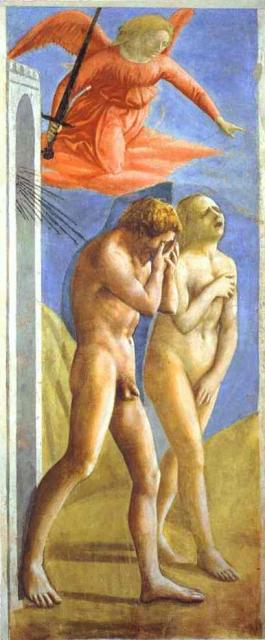
Expulsion from Eden, Masaccio, fresco from Brancacci Chapel, Florence.
Image from
 http://archives.evergreen.edu/webpages/curricular/2006-2007/greeceanditaly/massacio-expulsion-from-eden-1427-fresco-from-brancacci-chapel-florence/index.html

Masaccio's Expulsion from Eden, 1427, fresco from Brancacci Chapel, Florence was drawn by Michelangelo (Copy of Masaccio, Expulsion c.1490).


Copy of Masaccio, Expulsion. Michelangelo, Drawing, c. 1490

Tribute Money, located in the Chapel of Santa Maria della Carmine, Florence, Italy is perhaps one of the most recognized works of Masaccio.  Masaccio based the heads of the figures on classical heads yet his figures were akin to Donatello's.

Tribute Money, Fresco, 1426-28, 255 x 598 cm, Masaccio, Chapel of Santa Maria della Carmine in
Florence, Italy. Image from Hanover College

Masaccio was not the inventor of linear perspective but perhaps completed one of the early Renaissance's most effective use of perspective in The Holy Trinity.  Unknowingly, Masaccio would further the argument of mathematics as a true science. Masaccio constructed the fresco carefully according to the lines of linear perspective which Brunelleschi had perfected and painted the work to be seen from eye-level.  

The Holy Trinity, 1425, Masaccio. Santa Maria Novella, Florence, Italy. Here the lines following Masaccio's actual geometric framework are overlaid to make clear the structure of the perspective itself. Image obtained from McMurry University

The viewer first encounters the skeleton and inscription "I was once that which you are; and that which I am you will become." The viewer is meant by the gaze of only one individual in the fresco, the Virgin who invites the viewer into this constructed illusion and hence into contemplation of their humanity and meditation on her son.

 The Holy Trinity, 1425, Masaccio. Santa Maria Novella, Florence, Italy
Image obtained from http://legacy.earlham.edu/~vanbma/20th%20century/images/surveydaytwentynine.htm


Saturday, May 5, 2012

Angels and the Sacred Made Real


Are We Not All Angels?


Angels by Anthony Trott


Angels by Anthony Trott

The Angel with the Broken Wing

I am the Angel with the Broken Wing,
The one large statue in this quiet room.
The staff finds me too fierce, and so they shut
Faith’s ardor in this air-conditioned tomb.

The docents praise my elegant design
Above the chatter of the gallery.
Perhaps I am a masterpiece of sorts—
The perfect emblem of futility.

Mendoza carved me for a country church.
(His name’s forgotten now except by me.)
I stood beside a gilded altar where
The hopeless offered God their misery.

I heard their women whispering at my feet—
Prayers for the lost, the dying, and the dead.
Their candles stretched my shadow up the wall,
And I became the hunger that they fed.

I broke my left wing in the Revolution
(Even a saint can savor irony)
When troops were sent to vandalize the chapel.
They hit me once—almost apologetically.

For even the godless feel something in a church,
A twinge of hope, fear? Who knows what it is?
A trembling unaccounted by their laws,
An ancient memory they can’t dismiss.

There are so many things I must tell God!
The howling of the dammed can’t reach so high.
But I stand like a dead thing nailed to a perch,
A crippled saint against a painted sky.

~ BY DANA GIOIA

When I read this I immediately thought of the exhibit at the National Gallery of Art in Washington, D. C., The Sacred Made Real which highlighted Spain's mostly wooden sculptures that leave the churches once a year for Holy Week clad in real clothing and  are venerated as they are carried thru the streets during the week. 


Mater Dolorosa Roldan. Our Lady of Sorrows
(Mater Dolorosa) by Pedro Roldán
I am often amazed by paintings that seem to defy the picture plane, but nothing prepared this self-professed humanist for the visceral emotions caused by the tears, blood, sweat, bruises, and wounds so realistically rendered on these statues.  They are nothing short of master pieces and miracles.  I had to sit in a mesmerized state for the longest time, transfixed by the beauty in the pain.  I wondered what stories they would tell if they could speak - and trust me it seemed that at any moment they would just move and tell me their secrets..... 

This poem reminded me of that day, of that exhibit, of that profound emotion which was beyond religion, beyond gender or race or creed or station..... 


Gregorio Fernández, Dead Christ (detail), 1625-30, ©
Photo Imagen M.A.S. Courtesy of Museo Nacional del Prado, Madrid
As a human being seeing the straining in the veins, the tears on the cheeks, the sorrow in the eyes, the thorns pushed into Jesus' head, and knowing that for centuries people in the streets follow them with so many hopes, fears, and prays was so moving.  


Pedro de Mena (1628–1688)Christ as the Man of Sorrows (Ecce Homo) 

This poem embodies all those things.... What would these sculptures say after all they have seen.... What would the angels say? Not all angels need wings do they?


Spanish Pietà - The artist of this sculpture (polychromed plaster, wood and other materials), circa 1680-1700, is unknown. Polychromed plaster, macerated linen fibers, gesso- or glue-soaked fabric wood, papier-machÃ


Saturday, March 24, 2012

Many Ways to Walk in Beauty


Domenico Corvi - Allegory of Painting [1764]


She Walks in Beauty

She walks in beauty, like the night
Of cloudless climes and starry skies,
And all that's best of dark and bright
Meets in her aspect and her eyes;
Thus mellow'd to that tender light
Which Heaven to gaudy day denies.

One shade the more, one ray the less,
Had half impair'd the nameless grace
Which waves in every raven tress
Or softly lightens o'er her face,
Where thoughts serenely sweet express
How pure, how dear their dwelling-place.

And on that cheek and o'er that brow
So soft, so calm, yet eloquent,
The smiles that win, the tints that glow,
But tell of days in goodness spent,—
A mind at peace with all below,
A heart whose love is innocent.

~ Lord Byron

Meditation on the History of Italy - Francesco Hayez, 1850
Boreas, 1902, John William Waterhouse


Monday, February 27, 2012

Lost in Translation or Gained in Translation?? I Think Gained.... Seize the Day

One of the most interesting situations with works of art in written form is translating the words from one language to another.  Anyone who has learned or is learning an additional language or three knows that literal translations are rarely possible and are often confusing.  Poetry then, which relies creative use of a language complicates translation even more.  The outcome can be quite beautiful should the reader allow for the various translations to be taken as a unique perspective on the Poem.  Because I love Art History, Art and Poetry I love the 'Torso of an Archaic Apollo" (Archaischer Torso Apollos).  I have attached the original poem and two translations to illustrate how in translation even the translator must apply their artistic abilities to convey the original intent of the poem as best they can while changing the wording into a new language.... I hope you enjoy....


Torso of an Archaic Apollo
Translated by C. F. MacIntyre

Never will we know his fabulous head
where the eyes' apples slowly ripened. Yet
his torso glows: a candelabrum set
before his gaze which is pushed back and hid,

restrained and shining. Else the curving breast
could not thus blind you, nor through the soft turn
of the loins could this smile easily have passed
into the bright groins where the genitals burned.

Else stood this stone a fragment and defaced,
with lucent body from the shoulders falling,
too short, not gleaming like a lion's fell;

nor would this star have shaken the shackles off,
bursting with light, until there is no place
that does not see you. You must change your life.

~Rainer Maria Rilke

Torso of Apollo, Probably a Copy after a statue of Onatas from Aegina (ca.460 BCE), Munich
Rilke: Archaic Torso of Apollo

We didn’t understand that outrageous head, the eyes
whose irises actually flowered. But his torso
still stares like a chandelier turned low,
dimmed to illuminate just its own steady

flame. Why else would the crease
of the chest muscles blind you? And the slight
tensing of the loin — it’s nothing if not a smile
traveling to his center on a journey to procreation.

If not, this would only be a fragment
of mutilated stone under the shoulders’ transparent
slump. Wouldn’t glisten, anymore than a predator’s

fur, or leap like radiating star fire.
Because there isn’t any single part of it that isn’t
watching you. You have to live another life.

                                               — Trans. Art Beck 2007


Male Torso, Hellenistic Theater of Miletus, 480-470 BCE, Musee du Louvre
Archaischer Torso Apollos

Wir kannten nicht sein unerhörtes Haupt,
darin die Augenäpfelreiften. Aber
sein Torso glüht noch wie ein Kandelaber,
in dem sein Schauen, nur zurückgeschraubt,

sich hält und glänzt. Sonst könnte nicht der Bug
der Brust dich blenden, und im leisen Drehen
der Lenden könnte nicht ein Lächeln gehen
zu jener Mitte, die die Zeugung trug.

Sonst stünde dieser Stein enstellt und kurz
unter der Schultern  durchsichtigem Sturz
und flimmerte nicht so wie Raubtierfelle;

und bräche nicht  aus allen seinen Rändern
aus wie ein Stern: denn da ist keine Stelle,
die dich nicht sieht. Du mußt dein Leben ändern.

Friday, August 26, 2011

Judith Beheading Holofernes by Caravaggio

Judith Beheading Holofernes, Caravaggio, Oil on Canvas, 1598/99, National Gallery of Ancient Art of Barberini Palace, Rome, Italy
In honor of women in America having Congress finally pass our rights to vote on this day in 1920 thereby 'validating' what we already knew - we are powerful, smart, ingenious, fiercely loyal, fight for our cause, and protect our own I am putting up Judith.  Judith has an entire book in the bible devoted to her as she empowered the whole of Israel to defeat their enemy who even with superior numbers had their commander beheaded by the cunning and determination of one determined woman.  In his desire to have Judith, Holofernes underestimates her abilities and literally and figuratively loses his head.

Caravaggio paints Holofernes with a red drapery tauntingly over his head much like would be over royalty in an Academic painting echoing the red which soon escapes the neck of Holofernes.  Caravaggio never disappoints in his use of realism and naturalism. The dead eyes of Holofernes while his hands are still at their last grasping moment on the sheets, his agape mouth as if in mid-scream,  his taunt muscles about to succumb to death juxtaposed to the white purity of Judith's sheer blouse revealing her femininity (it actually used to reveal a breast but was covered up some time later by others) eluding to her use of sexual wiles to seduce the commander in a necessary evil for her family and her people.  Judith's facial expressions clearly echo the sentiment of distain, anger, and determination in her act while her maid's natural depiction of age and resolve bring yet another realistic element to this painting.

Caravaggio's interplay of angles and triangles created connections between individuals in the frame, further drama beyond the story and discord to the viewer's eye.  Chiaroscuro may not have been the invention of Caravaggio, but he certainly was in my opinion the master and this painting in print and in person confirms that fact.  If you have not seen Caravaggio's work in person it is a must because the subtleties, the nuances, the intricacies will astound even the mildest of art connoisseur....

How important it is for us to recognize and celebrate our heroes and she-roes!  ~Maya Angelou