Showing posts with label Timeless. Show all posts

Saturday, June 2, 2012

The Broken Heart


El Abrazo, Oil on Canvas, 2006, Santiago Carbonell

He is stark mad, whoever says,
    That he hath been in love an hour,
Yet not that love so soon decays,
    But that it can ten in less space devour ;
Who will believe me, if I swear
That I have had the plague a year?
    Who would not laugh at me, if I should say
    I saw a flash of powder burn a day?

Ah, what a trifle is a heart,
    If once into love's hands it come !
All other griefs allow a part
    To other griefs, and ask themselves but some ;
They come to us, but us love draws ;
He swallows us and never chaws ;
    By him, as by chain'd shot, whole ranks do die ;
    He is the tyrant pike, our hearts the fry.
Don't You Remember, Ryan DeLaurentis His Weblink


If 'twere not so, what did become
    Of my heart when I first saw thee?
I brought a heart into the room,
    But from the room I carried none with me.
If it had gone to thee, I know
Mine would have taught thine heart to show
    More pity unto me ; but Love, alas !
    At one first blow did shiver it as glass.

Yet nothing can to nothing fall,
    Nor any place be empty quite ;
Therefore I think my breast hath all
    Those pieces still, though they be not unite ;
And now, as broken glasses show
A hundred lesser faces, so
    My rags of heart can like, wish, and adore,
    But after one such love, can love no more.

~ John Donne

Love at first sight, in an instant can affect us and make our world feel whole and complete.... make a flash ('a flash of powder burn a day) feel like eternity until love destroys the heart that feels love, but like a mirror shattered on the floor a broken heart ('Those pieces still, though they be not unite; And now, as broken glasses show - A hundred lesser faces....') shattered shows love even in the shattered heart.... It is part of the broken hearted only amplified and reflected hundreds of times over.  The heart of the love lost remains, but in painful shards. After such a strong, passionate, love at first sight and whole love described Donne writes 'But after one such love, can love no more.' - perhaps it is not that love is not possible, but this kind of love is a once in a lifetime love, not shattered and painfully gone.

Monday, May 21, 2012

I Wonder Why You Call to Me Nearly a Year Later Lovelace


To Althea, From Prison

'Longing For Freedom' Alicepopkorn

When love with unconfined wings
Hovers within my gates,
And my divine Althea brings
To whisper at the grates;
When I lie tangled in her hair,
And fettered to her eye,
The birds that wanton in the air
Know no such liberty.

 Florian Imgrund http://www.inthoughts.de/portfolio.html
When flowing cups run swiftly round
With no allaying Thames,
Our careless heads with roses bound,
Our hearts with loyal flames;
When thirsty grief in wine we steep,
When healths and draughts go free,
Fishes that tipple in the deep
Know no such liberty.

When, like committed linnets, I
With shriller throat shall sing
The sweetness, mercy, majesty,
And glories of my King;
When I shall voice aloud how good

He is, how great should be,
Enlarged winds that curl the flood
Know no such liberty.

'Free' by Alicepopkorn 
Stone walls do not a prison make,
Nor iron bars a cage;
Minds innocent and quiet take, That for an hermitage;
If I have freedom in my love,
And in my soul am free,
Angels alone, that soar above,
Enjoy such liberty.

~by Richard Lovelace

Lovelace, dear friend, perhaps you call again because my mind is even freer, my imagination more full of hopes/dreams/desires/future.... Laurel leaves will come and go and wine may flow now but not later but I am here.... I am still here. 

I may be a temporary captive by my commitment to my degree at UF but I can see my freedom clearly on the horizon and my heart sings so loudly it thunders all other sounds; I have concentrated on my love of the arts and they have freed me even in my self imposed educational confinement and my joy and soul soar............ 


So now with only a matter of weeks from completing my degree. I know so much more, feel so much more, 'see' so much more, am so very much more.......

Friday, May 4, 2012

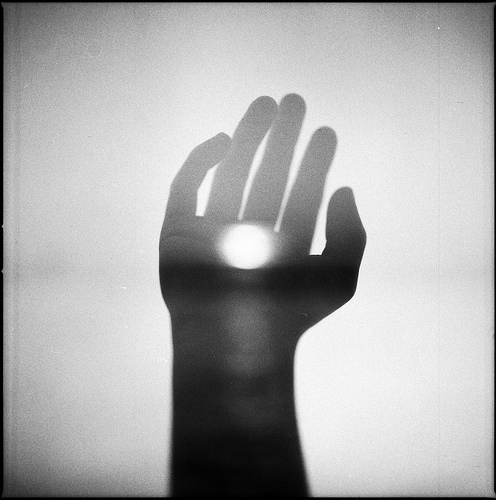
If I had the brain to see.....A Grain of Sand AND InThoughts Photography

A Grain of Sand
If starry space no limit knows,
And sun succeeds to sun,
There is no reason to suppose,
Our earth the only one.


'Mid countless constellations cast
      A million worlds may be,
With each a God to bless or blast
      And steer to destiny.
      
Just think! A million gods or so
      To guide each vital stream,
With over all to boss the show
      A Deity supreme.


Such magnitudes oppress my mind; 
From cosmic space it swings;
So ultimately glad to find - Relief in little things.


For look! Within my hollow hand,
While round the earth careens,
I hold a single grain of sand;
And wonder what it means.


Ah! If I had the eyes to see,
      And brain to understand,
I think Life's mystery might be
      Solved in this grain of sand.


~Robert W Service, Poet


Photographer - Artist Statement - 'The unique charm of analog photographs connected with the original handcraft of photography fascinates me. After I got my first analog camera in summer of 2010 I started shooting more and more. This growing portfolio is the result of my passion. All of these photographs are captured on film, self developed and without any computer manipulation. I hope you‘ll enjoy it.' ~ Florian Imgrund http://www.inthoughts.de/portfolio.html


Monday, February 27, 2012

Lost in Translation or Gained in Translation?? I Think Gained.... Seize the Day

One of the most interesting situations with works of art in written form is translating the words from one language to another.  Anyone who has learned or is learning an additional language or three knows that literal translations are rarely possible and are often confusing.  Poetry then, which relies creative use of a language complicates translation even more.  The outcome can be quite beautiful should the reader allow for the various translations to be taken as a unique perspective on the Poem.  Because I love Art History, Art and Poetry I love the 'Torso of an Archaic Apollo" (Archaischer Torso Apollos).  I have attached the original poem and two translations to illustrate how in translation even the translator must apply their artistic abilities to convey the original intent of the poem as best they can while changing the wording into a new language.... I hope you enjoy....


Torso of an Archaic Apollo
Translated by C. F. MacIntyre

Never will we know his fabulous head
where the eyes' apples slowly ripened. Yet
his torso glows: a candelabrum set
before his gaze which is pushed back and hid,

restrained and shining. Else the curving breast
could not thus blind you, nor through the soft turn
of the loins could this smile easily have passed
into the bright groins where the genitals burned.

Else stood this stone a fragment and defaced,
with lucent body from the shoulders falling,
too short, not gleaming like a lion's fell;

nor would this star have shaken the shackles off,
bursting with light, until there is no place
that does not see you. You must change your life.

~Rainer Maria Rilke

Torso of Apollo, Probably a Copy after a statue of Onatas from Aegina (ca.460 BCE), Munich
Rilke: Archaic Torso of Apollo

We didn’t understand that outrageous head, the eyes
whose irises actually flowered. But his torso
still stares like a chandelier turned low,
dimmed to illuminate just its own steady

flame. Why else would the crease
of the chest muscles blind you? And the slight
tensing of the loin — it’s nothing if not a smile
traveling to his center on a journey to procreation.

If not, this would only be a fragment
of mutilated stone under the shoulders’ transparent
slump. Wouldn’t glisten, anymore than a predator’s

fur, or leap like radiating star fire.
Because there isn’t any single part of it that isn’t
watching you. You have to live another life.

                                               — Trans. Art Beck 2007


Male Torso, Hellenistic Theater of Miletus, 480-470 BCE, Musee du Louvre
Archaischer Torso Apollos

Wir kannten nicht sein unerhörtes Haupt,
darin die Augenäpfelreiften. Aber
sein Torso glüht noch wie ein Kandelaber,
in dem sein Schauen, nur zurückgeschraubt,

sich hält und glänzt. Sonst könnte nicht der Bug
der Brust dich blenden, und im leisen Drehen
der Lenden könnte nicht ein Lächeln gehen
zu jener Mitte, die die Zeugung trug.

Sonst stünde dieser Stein enstellt und kurz
unter der Schultern  durchsichtigem Sturz
und flimmerte nicht so wie Raubtierfelle;

und bräche nicht  aus allen seinen Rändern
aus wie ein Stern: denn da ist keine Stelle,
die dich nicht sieht. Du mußt dein Leben ändern.

Saturday, December 31, 2011

Tennyson's New Year's Eve juxtaposed to our 2011

Australian Scott Jones kisses Canadian girlfriend Alex Thomas after she was knocked to the ground by a police officer's riot shield in Vancouver, British Columbia. (Getty Images/Rich/Lam)

I chose this photograph for this poem to represent so much of what is going on in the world right now and I cannot say as much as a photograph can..... so may 2012 be more peaceful and head in a more loving direction for all....


In Memoriam

Ring out, wild bells, to the wild sky,    
The flying cloud, the frosty light:    
The year is dying in the night;
Ring out, wild bells, and let him die. 

Ring out the old, ring in the new,
Ring, happy bells, across the snow:    
The year is going, let him go;
Ring out the false, ring in the true. 

Ring out the grief that saps the mind    
For those that here we see no more;    
Ring out the feud of rich and poor,
Ring in redress to all mankind. 

Ring out a slowly dying cause,    
And ancient forms of party strife;    
Ring in the nobler modes of life,
With sweeter manners, purer laws. 

Ring out the want, the care, the sin,    
The faithless coldness of the times;    
Ring out, ring out my mournful rhymes
But ring the fuller minstrel in. 

Ring out false pride in place and blood,    
The civic slander and the spite;    
Ring in the love of truth and right,
Ring in the common love of good. 

Ring out old shapes of foul disease;    
Ring out the narrowing lust of gold;    
Ring out the thousand wars of old,
Ring in the thousand years of peace. 

Ring in the valiant man and free,    
The larger heart, the kindlier hand;    
Ring out the darkness of the land,
Ring in the Christ that is to be.

Thursday, August 4, 2011

Ophelia or La Jeune Martyre


La Jeune Martyre, Paul Delaroche, 1855, Louvre, Paris

There’s rosemary, that’s for remembrance; pray,
love, remember: and there is pansies. that’s for thoughts.
There’s fennel for you, and columbines: there’s rue
for you; and here’s some for me: we may call it
herb-grace o’ Sundays: O you must wear your rue with
a difference. There’s a daisy: I would give you
some violets, but they withered all when my father
died: they say he made a good end
[William Shakespeare, Hamlet, Atto IV, Scena V]


Many people mistake Delaroche's La Jeune Martyre for Ophelia; however Delaroche was a history painter and this is a depiction of the young female Christian Martyr in the 3rd CE.  Historical paintings of Delaroche's time include but are not limited to biblical histories.  The  most obvious give away this is not Ophelia is the bound hands as Ophelia took her life and La Jeune Martyre had her life taken.  As I stood in front of this awe inspiring painting in the Louvre I wanted to jump through the canvas and save her. She looked as if she had just succumb to the water and there was time to save her life.  Every aspect of the paint, light, coloration, reflections, and shadow captivates the viewer and draws them into the scene unfolding before them.  Although the martyrs eyes are closed I felt as if she was looking at the viewer still, but not in a desperate request for saving, rather in a resolve of peace with what has happened.  It is quite powerful.

Friday, July 8, 2011

Narcissus and Echo

The Metamorphosis of Narcissus (Métamorphose de Narcisse), Oil on Canvas,1937, Salvador Dali, Tate Modern Museum, London


Narcissus ...

Narcissus, who was never very wise,
Observed a water-spirit in a pond
And grew enamored of the comely blonde
Who matched his gaze and filled his shallow eyes.

Through all the dawns, it never dawned on him
Why such a face would shatter at a tear
And flee his touch or why the pond's veneer
Would duplicate an overhanging limb.

The spirits featured in the face of waves,
The lips of fountains or the fountainhead
Are images of us in nature's stead,
Reflecting on the way the world behaves,

And as the spring of youth matures tomorrow
To Old Man Winter and old age, we look
And look and ask the figure in the brook,
As long ago Narcissus did, "Who are you?"


... And Echo

Echo, who tricked a Queen with her replies,
Received a sentence only to respond
And gradually became a vagabond,
A voice, unable to extemporize.

Seeing Narcissus at the water's brim,
She fell in love, but when he said, "Come here,"
The timbre of the forest said, "Come, hear,"
And she became the selfless eponym

For words we put into the mouths of caves,
The teeth of canyons and the woodenhead
Ravines.  Though nature's ministries seem led
By honest voices in the open naves,

Divine and inspirational and true,
The words resounding from an overlook
Are only ours, as once beside a brook,
Narcissus heard from Echo, "Who are you?"

Greg Williamson