Showing posts with label Painting. Show all posts

Saturday, April 13, 2013

Take the World As It Is

Daniel Sprick, Still Life & Mirror, 2004, Oil & Board


TAKE the world as it is!—there are good and bad in it,
  And good and bad will be from now to the end;
And they, who expect to make saints in a minute,
  Are in danger of marring more hearts than they ’ll mend. If ye wish to be happy ne’er seek for the faults,        5
  Or you ’re sure to find something or other amiss;
’Mid much that debases, and much that exalts,
  The world’s not a bad one if left as it is.

Daniel Sprick, Peeled Orange, 1999, Oil & Board

Take the world as it is!—if the surface be shining,
  Ne’er rake up the sediment hidden below!        10
There ’s wisdom in this, but there ’s none in repining
  O’er things which can rarely be mended, we know.
There ’s beauty around us, which let us enjoy;
  And chide not, unless it may be with a kiss;
Though Earth’s not the Heaven we thought when a boy,         
  There ’s something to live for, if ta’en as it is.

Daniel Sprick, Landscape & Pansies, 2003, Oil & Board

Take the world as it is!—with its smiles and its sorrow,
  Its love and its friendship,—its falsehood and truth,
Its schemes that depend on the breath of to-morrow,
  Its hopes which pass by like the dreams of our youth:         
Yet, oh! whilst the light of affection may shine,
  The heart in itself hath a fountain of bliss;
In the worst there ’s some spark of a nature divine,
  And the wisest and best take the world as it is.

Daniel Sprick, Release Your Plans, 2001, Oil & Board

~ Charles Swain (1803–74)


I could think of no better images for this poem than a set of 'Still-Life' images/paintings.  A Still-Live painting comprises inanimate, yet many common objects, which upon close inspection remind us of vanitas (life's fleeting moments/quality). Like this poem, 'Take the World As It Is', these paintings incorporate both the beauty as well as what truly lies beneath the initial view. All things are beauty and all things are fleeting. 

Francesco Salviati, 1552/54, Kairos (Caerus), Fresco, Audience Hall of the Palazzo Sacchetti, Rome, Italy
This notion is not new, nor are 'Still-Lives' and similar to Kairos (or Caerus) the Greek god (youngest divine son of Zeus and in Roman gods is known as either Tempus or Occasio), Kairos never gets old, is always beautiful, is always opportune and flourishes in its season yet, is always on the run.  Kairos holds balanced schales with sharp edges alluding to the instant when opportunity is available, much like life's opportunities and moments are available...Only for a moment, then they are past. 

Aesop's Fable 536 (from Phaedrus 5. 8) (trans. Gibbs) (Greek fable C6th B.C.) : "Running swiftly, balancing on the razor's edge, bald but with a lock of hair on his forehead, he wears no clothes; if you grasp him from the front, you might be able to hold him, but once he has moved on not even Juppiter [Zeus] himself can pull him back: this is a symbol of Tempus [Kairos, Opportunity], the brief moment in which things are possible." [N.B. This fable is associated with famous statue of Kairos at Olympia by the Greek sculptor Lysippos of the C4th B.C. The Greek name Kairos is rendered as Tempus in this Latin version of Aesop's fable.]" Kairos

Seize the moments, the beauty, the opportunity and yet do not deny what makes it so. All things have something lying beneath. ~ Fred

Monday, September 17, 2012

Symphony and Cortny


Part of a statement from the artist aka Cort. "Too bad art can't be viewed as a valuable way to earn a living! I think that is why dreamers are quite often artists and artists are quite often dreamers! I have always been confused with one foot in dream world and one in reality!" ~ Cortny Linton Eorgan

Symphony 
SerWRENity, 30"x40" acrylic on canvas, Cort (Cortny Linton Eorgan)

To live content with small means
to seek elegance rather than luxury,
and refinement rather than fashion;
to be worthy, not respectable,
and wealthy, not rich;

VA Tree, 24"x36" acrylic on canvas, Cort (Cortny Linton Eorgan)
to study hard, think quietly,
talk gently, act frankly;
to listen to stars and birds,
to babes and sages, with open heart;
to bear all cheerfully, do all bravely,
await occasions, hurry never.

Angel's Trumpet, 36"x36" acrylic on canvas, Cort (Cortny Linton Eorgan)
In a word, to let the spiritual,
unbidden and unconscious,
grow up through the common.
This is to be my symphony.

~William Henry Channing 


~~~~~~~~~~~~~~~~~~~~~~~~~~~~~~~~
Cort (Cortny Linton Eorgan) is an amazing artist who has a very unique style (so hard to come by these days), makes beautiful use of shape and color, and uses her subjects in the most extraordinary ways.  

I am fortunate in that I know Cort and have heard her talk about her art and when she does, she lights up from the inside.  Cort truly listens to nature and people and so this poem was perfect for her. I see Cort's painting techniques and subjects with a soul that is truly "spiritual, unbidden and unconscious toward beautiful results".

You can find out more about Cort and her artwork at her website.  The artist recently had a show titled 'Take A Hike' at Boones Creek Potters Gallery.

To Have and Hold, 20"x24" acrylic on canvas, Cort (Cortny Linton Eorgan)

Thursday, August 16, 2012

Autumn

Autumn On The Hudson River, Jasper Francis Cropsey, 1860. National Gallery of Art

SEASON of mists and mellow fruitfulness, 
        Close bosom-friend of the maturing sun; 
    Conspiring with him how to load and bless 
        With fruit the vines that round the thatch-eves run; 
    To bend with apples the moss’d cottage-trees, 
        And fill all fruit with ripeness to the core; 
            To swell the gourd, and plump the hazel shells 
    With a sweet kernel; to set budding more, 
        And still more, later flowers for the bees, 
        Until they think warm days will never cease, 
            For Summer has o’er-brimm’d their clammy cells.
                                           
    Who hath not seen thee oft amid thy store? 
        Sometimes whoever seeks abroad may find 
    Thee sitting careless on a granary floor, 
        Thy hair soft-lifted by the winnowing wind; 
    Or on a half-reap’d furrow sound asleep, 
        Drows’d with the fume of poppies, while thy hook 
            Spares the next swath and all its twined flowers: 
    And sometimes like a gleaner thou dost keep 
        Steady thy laden head across a brook; 
        Or by a cyder-press, with patient look, 
            Thou watchest the last oozings hours by hours.
                                            
    Where are the songs of Spring? Ay, where are they? 
        Think not of them, thou hast thy music too,— 
    While barred clouds bloom the soft-dying day, 
        And touch the stubble plains with rosy hue; 
    Then in a wailful choir the small gnats mourn 
        Among the river sallows, borne aloft 
            Or sinking as the light wind lives or dies; 
    And full-grown lambs loud bleat from hilly bourn; 
        Hedge-crickets sing; and now with treble soft 
        The red-breast whistles from a garden-croft; 
           And gathering swallows twitter in the skies.

~John Keats (1795-1821)

Fall Lighthouse, Lake Michigan, 2006, fred


Saturday, May 5, 2012

Angels and the Sacred Made Real


Are We Not All Angels?


Angels by Anthony Trott


Angels by Anthony Trott

The Angel with the Broken Wing

I am the Angel with the Broken Wing,
The one large statue in this quiet room.
The staff finds me too fierce, and so they shut
Faith’s ardor in this air-conditioned tomb.

The docents praise my elegant design
Above the chatter of the gallery.
Perhaps I am a masterpiece of sorts—
The perfect emblem of futility.

Mendoza carved me for a country church.
(His name’s forgotten now except by me.)
I stood beside a gilded altar where
The hopeless offered God their misery.

I heard their women whispering at my feet—
Prayers for the lost, the dying, and the dead.
Their candles stretched my shadow up the wall,
And I became the hunger that they fed.

I broke my left wing in the Revolution
(Even a saint can savor irony)
When troops were sent to vandalize the chapel.
They hit me once—almost apologetically.

For even the godless feel something in a church,
A twinge of hope, fear? Who knows what it is?
A trembling unaccounted by their laws,
An ancient memory they can’t dismiss.

There are so many things I must tell God!
The howling of the dammed can’t reach so high.
But I stand like a dead thing nailed to a perch,
A crippled saint against a painted sky.

~ BY DANA GIOIA

When I read this I immediately thought of the exhibit at the National Gallery of Art in Washington, D. C., The Sacred Made Real which highlighted Spain's mostly wooden sculptures that leave the churches once a year for Holy Week clad in real clothing and  are venerated as they are carried thru the streets during the week. 


Mater Dolorosa Roldan. Our Lady of Sorrows
(Mater Dolorosa) by Pedro Roldán
I am often amazed by paintings that seem to defy the picture plane, but nothing prepared this self-professed humanist for the visceral emotions caused by the tears, blood, sweat, bruises, and wounds so realistically rendered on these statues.  They are nothing short of master pieces and miracles.  I had to sit in a mesmerized state for the longest time, transfixed by the beauty in the pain.  I wondered what stories they would tell if they could speak - and trust me it seemed that at any moment they would just move and tell me their secrets..... 

This poem reminded me of that day, of that exhibit, of that profound emotion which was beyond religion, beyond gender or race or creed or station..... 


Gregorio Fernández, Dead Christ (detail), 1625-30, ©
Photo Imagen M.A.S. Courtesy of Museo Nacional del Prado, Madrid
As a human being seeing the straining in the veins, the tears on the cheeks, the sorrow in the eyes, the thorns pushed into Jesus' head, and knowing that for centuries people in the streets follow them with so many hopes, fears, and prays was so moving.  


Pedro de Mena (1628–1688)Christ as the Man of Sorrows (Ecce Homo) 

This poem embodies all those things.... What would these sculptures say after all they have seen.... What would the angels say? Not all angels need wings do they?


Spanish Pietà - The artist of this sculpture (polychromed plaster, wood and other materials), circa 1680-1700, is unknown. Polychromed plaster, macerated linen fibers, gesso- or glue-soaked fabric wood, papier-machÃ


Saturday, March 24, 2012

Many Ways to Walk in Beauty


Domenico Corvi - Allegory of Painting [1764]


She Walks in Beauty

She walks in beauty, like the night
Of cloudless climes and starry skies,
And all that's best of dark and bright
Meets in her aspect and her eyes;
Thus mellow'd to that tender light
Which Heaven to gaudy day denies.

One shade the more, one ray the less,
Had half impair'd the nameless grace
Which waves in every raven tress
Or softly lightens o'er her face,
Where thoughts serenely sweet express
How pure, how dear their dwelling-place.

And on that cheek and o'er that brow
So soft, so calm, yet eloquent,
The smiles that win, the tints that glow,
But tell of days in goodness spent,—
A mind at peace with all below,
A heart whose love is innocent.

~ Lord Byron

Meditation on the History of Italy - Francesco Hayez, 1850
Boreas, 1902, John William Waterhouse


Thursday, March 22, 2012

Bond and Free - Frost & Francois Boucher

'Fountain of Venus', 1756, Francois Boucher, French Oil on Canvas
CopyRight at bottom of page from Cleveland Museum of Art
Bond and Free


Love has earth to which she clings 
With hills and circling arms about-- 
Wall within wall to shut fear out. 
But Though has need of no such things, 
For Thought has a pair of dauntless wings. 


On snow and sand and turn, I see 
Where Love has left a printed trace 
With straining in the world's embrace. 
And such is Love and glad to be 
But Though has shaken his ankles free. 


Though cleaves the interstellar gloom 
And sits in Sirius' disc all night, 
Till day makes him retrace his flight 
With smell of burning on every plume, 
Back past the sun to an earthly room. 


His gains in heaven are what they are. 
Yet some say Love by being thrall 
And simply staying possesses all 
In several beauty that Thought fares far 
To find fused in another star.


~Robert Frost, 1916


The Toilet of Venus, 1751, Francois Boucher, French, Oil on Canvas
Copy Rights at the end of this post from The Metropolitan Museum of Art
Boucher utilized earth tones for the background and drapery around Venus so that when he used his delicate tones on Venus the viewer is immediately drawn to her.  The diagonal lines and implied lines draw the viewers' eyes around the canvas noting every detail of her toilet.  Boucher is famous for his use of color to portray a mythical event which invites the viewer into a world which is only achievable through art.  


Boucher's portrayal of Venus, the goddess of love, is in her toilet and as a fountain (in the painting above) grounding in earth and in earthly things.  This is quite common in portraying Venus after her 'birth'.  In relation to Frost's poetry the two artists are actually portraying a similar theme.... love exists here, on earth.... grounded by nature and our human needs and desires...


Frost initially compares love as being bound and confined while thought is free.... Love leaves marks as in the sand and snow... Thought has shaken it's ankle free.... By the 4th stanza Frost begins to show that thoughts must travel to the stars "And sit in Sirius' disc all night, Till day makes him retrace his flight..." while love in stanza 5 does not have to leave to effect anyone, it possesses all without ever going anywhere... Frost is emphasizing the importance of love and gentleness as thought is shackled without love...


Fountain of Venus, Boucher - This image was provided by The Cleveland Museum of Art. Contact information: Kathleen Kornell, Rights and Reproductions Coordinator, The Cleveland Museum of Art, 11150 East Blvd., Cleveland OH 44106, (216) 707-2498 (ph), (216) 421-8815 (fax), Kkornell@clevelandart.org. 

The Toilet of Venus, Boucher -This image was provided by The Metropolitan Museum of Art. Contact information: Image Library, The Metropolitan Museum of Art, 1000 Fifth Avenue, New York, NY 10028, (212) 396-5050 (fax), Scholars.License@MetMuseum.org Image © The Metropolitan Museum of Art 

Sunday, October 23, 2011

Invictus

Winds of Change, 30 x 40 Acrylic and Mixed Media on Canvas,
2008, Nancy Christy-Moore


Out of the night that covers me,
Black as the pit from pole to pole,
I thank whatever gods may be
For my unconquerable soul.
In the fell clutch of circumstance
I have not winced nor cried aloud.
Under the bludgeonings of chance
My head is bloody, but unbowed.
Beyond this place of wrath and tears
Looms but the Horror of the shade,
And yet the menace of the years
Finds and shall find me unafraid.
It matters not how strait the gate,
How charged with punishments the scroll,
I am the master of my fate:
I am the captain of my soul.


~ William Ernest Henley (1849-1903)


http://www.nchristy.com/gallery/hcan.php


Wednesday, October 12, 2011

Alley by the Lake

Alley by the Lake, by Leonid Afremov
So today is a two for one art day as I am behind on my blogging and because I am just wrapping up a course and in my folly of browsing artists I ran across this beautiful oil on 100% cotton canvas which was done using only a palette-knife.


This led me to his Facebook page and Oh my goodness I have just gone into art love overload so I wanted to share his page and his work! Enjoy my UF peeps and my art loving peeps!


https://www.facebook.com/profile.php?id=100001142078138&sk=photos

Monday, August 15, 2011

The Titan Prometheus

The Torture of Prometheus,1819, Jean-Louis-Cesar Lair , Musee Crozatier
In Greek mythology Prometheus, a Titan, was the son of Lapetus and Themis.  Prometheus, known for his wily intelligence,  greatest crime in Zeus' eyes was stealing and giving man fire as well as championing on the side of men.  Zeus being the father of the gods and ruler of Mount Olympus and the Sky punished Prometheus for his theft and treachery by chaining him and having an eagle eat his liver daily only for it to regenerate for the next day's torment.

Prometheus Bound is found in many of the Greek tragedy poems and plays and one of the best was attributed to the tragedian Aeschylus chronicling the punishment by Zeus.  Aeschylus adds in to Prometheus' role (Titanomachy) that he also taught humans the arts - writing, math, agriculture, medicine, and science.  Prometheus was also found in 4th CE place including such as Aesop and Ovid in the creation of the human race in which Prometheus decided to give humans fire and the arts.....

Thursday, August 4, 2011

Ophelia or La Jeune Martyre


La Jeune Martyre, Paul Delaroche, 1855, Louvre, Paris

There’s rosemary, that’s for remembrance; pray,
love, remember: and there is pansies. that’s for thoughts.
There’s fennel for you, and columbines: there’s rue
for you; and here’s some for me: we may call it
herb-grace o’ Sundays: O you must wear your rue with
a difference. There’s a daisy: I would give you
some violets, but they withered all when my father
died: they say he made a good end
[William Shakespeare, Hamlet, Atto IV, Scena V]


Many people mistake Delaroche's La Jeune Martyre for Ophelia; however Delaroche was a history painter and this is a depiction of the young female Christian Martyr in the 3rd CE.  Historical paintings of Delaroche's time include but are not limited to biblical histories.  The  most obvious give away this is not Ophelia is the bound hands as Ophelia took her life and La Jeune Martyre had her life taken.  As I stood in front of this awe inspiring painting in the Louvre I wanted to jump through the canvas and save her. She looked as if she had just succumb to the water and there was time to save her life.  Every aspect of the paint, light, coloration, reflections, and shadow captivates the viewer and draws them into the scene unfolding before them.  Although the martyrs eyes are closed I felt as if she was looking at the viewer still, but not in a desperate request for saving, rather in a resolve of peace with what has happened.  It is quite powerful.

Tuesday, July 19, 2011

I Have Dreamed of You so Much


I have dreamed of you so much that you are no longer real.
Is there still time for me to reach your breathing body, to kiss your mouth and make
your dear voice come alive again?

I have dreamed of you so much that my arms, grown used to being crossed on my 
chest as I hugged your shadow, would perhaps not bend to the shape of your body.
For faced with the real form of what has haunted me and governed me for so many 
days and years, I would surely become a shadow.

O scales of feeling.

I have dreamed of you so much that surely there is no more time for me to wake up. 
I sleep on my feet prey to all the forms of life and love, and you, the only one who 
counts for me today, I can no more touch your face and lips than touch the lips and 
face of some passerby.

I have dreamed of you so much, have walked so much, talked so much, slept so much 
with your phantom, that perhaps the only thing left for me is to become a phantom 
among phantoms, a shadow a hundred times more shadow than the shadow the 
moves and goes on moving, brightly, over the sundial of your life.


~ Robert Desnos


Painting - 'Flaming June', Lord Frederic Leighton, 1895

Monday, July 11, 2011

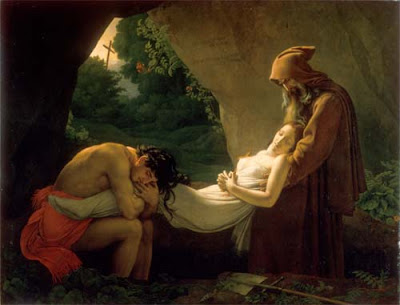
Atala, The Drama

The Funeral of Atala, ca. 1811, oil on canvas, Anne-Louis De Roussy Girodet Trioson, High Museum of Art, Atlanta, Georgia, United States of America

"If my dream of happiness was yet alive, it was also of short duration, and my awakening awaited me at the Hermit’s cave. I was surprised, on arriving there at midday, not to see Atala running to meet our steps. Some sudden horror seized me. Approaching the cave, I hardly dared to call to Lopez’s daughter: my imagination was equally terrified, as to whether sound or silence would succeed to my cries. Even more afraid of the darkness which prevailed at the rocky entrance, I said to the missionary: ‘O you, whom the heavens support and strengthen, penetrate these shadows.’
          How weak is the man whom passions dominate! How strong the man who trusts in God! There was more courage in that religious heart, burdened by its seventy-six years than in all my youthful ardour. The man of peace entered the cave, and I stood outside filled with terror. Soon a low murmur, like a complaint, issued from the depths of the rock, and struck my ear. Heaving a cry, and regaining my strength, I rushed into the darkness of the cavern ...Spirits of my Fathers: you alone know the sight that met my eyes!
   The Hermit had lit a torch of pine; he grasped it with a trembling hand over Atala’s bed. That lovely young woman half-raised on one elbow, appeared pale and dishevelled. Drops of sweat, the product of agony, glistened on her forehead; her eyes half-extinguished still seeking to express her love for me, and her mouth attempting to smile. Struck as if by a lightning-bolt, staring, arms outstretched, lips parted, I remained motionless. A profound silence reigned for a moment among the three personages at this scene of sorrow. The Hermit was first to break it: ‘This,’ he said, ‘is merely a fever brought on by fatigue, and if we resign ourselves to the will of God, he will take pity on us.’
          At these words, the flow of blood, which had seemed suspended, resumed its course through my heart, and with the adaptability of the Savage, I passed suddenly from excessive fear to excess trust. But Atala allowed me but a moment. Her head swaying sadly, she beckoned us to approach her bed.
          ‘My father,’ she said, in a faint voice, turning to the priest, ‘I am near to death. O Chactas! Listen without despair to the fatal secret I have concealed, in order not to render you wretched too, and to show obedience to my mother’s memory. Try not to interrupt me with expressions of sorrow, which would hasten the few moments I have left to live. I have many things to tell, with a heart whose beat is fading ... with an icy burden that my breast can scarcely bear … I feel I cannot be too swift.’
          After a few moments silence, Atala continued:
‘My sad fate began almost before I had seen the light. My mother conceived me in misfortune; I exhausted her womb, and her flesh was torn in giving birth to me: they despaired of my life. To preserve it, my mother uttered a vow: she promised to the Queen of Angels that I would dedicate my virginity to her, if I escaped death ... A fatal vow that sends me onwards to the tomb!
          I had just turned fifteen, when I lost my mother. A few hours before she died she called me to her bed. “My daughter,” she said, in the presence of the missionary who was bringing consolation to her last moments, “my daughter, you know the vow I made for you. Would you deny your mother? Oh, my Atala! I leave you in a world that is not worthy of possessing a Christian amidst all these idolaters, who persecute the God of your father and mine, that God who, after having granting you life, saved you by a miracle. Ah, my dear child, by accepting the virgin’s veil, you will simply be abandoning the cares of the wilderness and the fatal passions that have troubled your mother’s womb! Come, my beloved, come; swear on this picture of the Saviour’s Mother, held in the hands of this holy priest, and between those of your dying mother, so as not to compromise me in the sight of heaven. Remember that I gave a promise on your behalf in order to save your life, and if you do not keep my promise, you will plunge your mother’s soul into eternal torment.”
          O my mother! Why did you speak thus! O Religion that brings me both pain and happiness, that destroys and consoles me! And you, dear and sad object of a passion that consumes me to the very point of death, you see now, O Chactas, what has determined the severity of our fate! ... Bursting into tears, and throwing myself into my mother’s arms, I promised all that I was asked to promise. The missionary pronounced the terrible words over me, and handed me the scapular that binds me forever. My mother threatened me with her curse if I ever broke my vows, and after having recommended me to keep that secret hidden inviolably from the heathen persecutors of my religion, she died, while holding me in her embrace.
          I did not at first realise the danger of my oaths. Full of enthusiasm, and a true Christian, proud of the Spanish blood flowing through my veins, I could see only men around me who were unworthy to receive my hand; I congratulated myself on having no other spouse but my mother’s God. I saw you, a young handsome captive, I was moved by your fate, I dared to speak to you at the stake in the forest; thus I felt the whole weight of my vows.’
          As Atala finished speaking these words, clenching my fists, and glaring at the missionary with a menacing expression, I exclaimed: ‘This then is the religion you praised so highly! Have done with this vow that snatches Atala from me!" Excepts from  Chateaubriand's Atala 


The Funeral of Atala, ca. 1811, Anne-Louis Girodet de Roucy Trioson, Louvre